Zoraida’s Christian faith
Don QuixoteZoraida’s Christian faith is a defining part of her identity and her escape from Algiers: it begins in childhood, before she has received baptism, and becomes a motive for leaving her home and helping Christian captives reach safety. The account distinguishes inward belief from formal incorporation into the Church. Zoraida has made a deliberate religious choice, but the ceremony that would confirm it has not yet taken place when she arrives in Spain.
Childhood Belief and Devotion
As Zoraida explains through a written message, a Christian slave in her father’s household taught her a Christian prayer in her own language when she was a child. He also told her about Lela Marien. After the slave’s death, Zoraida believed that Lela Marien had appeared to her twice and directed her toward the land of the Christians. Her knowledge of Christianity therefore begins not with instruction by clergy or a public rite, but through personal teaching and a devotional relationship formed within her childhood home.
The message presents this faith as a source of both direction and confidence. Zoraida says that she wants to travel to Christian territory and believes Lela Marien cares for her. She also imagines that the saint will provide for her future there, whether or not Captain Viedma agrees to marry her. Her religious decision is thus not simply a consequence of attachment to him: in the message, she makes clear that she intends to go even if he declines her offer. At the same time, she proposes marriage as one possible future, linking her hope of a new life to both religious belonging and personal choice.
Maria and Zoraida
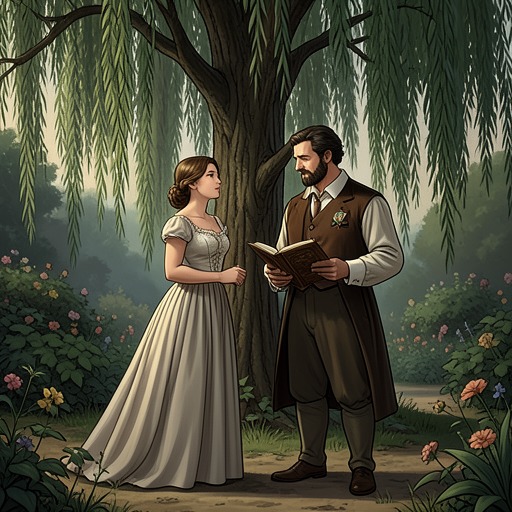
When Captain Viedma introduces her at the inn as Lela Zoraida, she promptly corrects him and insists on the name Maria. Her emphatic self-identification moves the people present, including Luscinda, who embraces her and repeats the name. Zoraida’s correction gives her faith a public expression: the name she chooses makes visible the Christian identity she has already formed, even though baptism has not yet occurred.
The scene also shows that the transition between names is not presented as a completed ceremony. Captain Viedma explains that Zoraida remains unbaptized because she has not had an opportunity since leaving Algiers, and because she has not faced an immediate danger of death that would require baptism before further instruction. He expects her eventually to be baptized with the proper solemnity. The distinction matters: those around her recognize her religious commitment, but the account does not describe her as having completed the formal rite. Maria is the name she claims, while baptism remains a future intention.
Faith, Escape, and Family Conflict
Zoraida’s belief becomes entangled with the practical risks of escape. Her message asks Captain Viedma to devise a way for them to travel to Christian territory and warns him to trust no Moor with the plan. She fears that if her father, Hadji Morato, discovers her intention, he may kill her. These details make her decision more than an abstract change of allegiance: the journey she seeks would separate her from her home and place her in direct conflict with her father’s authority.
On the appointed night, Captain Viedma and the renegade lead the Christian captives first to the vessel and then to Hadji Morato’s garden. The group secures the boat before going to the house, where Zoraida has been waiting. Once they reach the vessel, her father sees her dressed in her finest clothes and notices the small trunk of jewels that had remained in Algiers. The renegade tells him that she is a Christian, that she has helped free the captives, and that she came of her own will. Hadji Morato asks her directly whether this is true. Zoraida confirms her Christian identity but denies intending to abandon or injure him; she says she meant to do good for herself. Her words establish a painful distinction between the consequences of her choice and its stated purpose. She participates in an escape that leaves her father in the hands of his enemies, while insisting that harming him was not her aim.
Arrival and Uncompleted Baptism
After the escapees reach Velez Malaga, they go to the church to give thanks for their deliverance. There Zoraida sees images of the Virgin Mary and says that they have faces like Lela Marien’s. Her companions explain that these are images of the figure she has revered, and the renegade gives her an explanation of their significance. The moment brings the devotion learned in her childhood into the public setting of Christian worship: what had been sustained through memory, prayer, and reported visions is now encountered through the images and practices of a church.
The group remains in Velez for six days. The renegade then leaves for Granada to return to the Church through the Holy Inquisition, while Zoraida and Captain Viedma continue together. At this point, the narrative still describes her baptism as something to be undertaken later, not as an event already completed. Her faith has nevertheless shaped the course of the escape, her chosen name, and her response to the church in Spain. It is represented as a conviction she has acted upon, while the difference between personal commitment and formal sacrament remains unresolved at the close of the account.